
The Little Prince Quotes
The best The Little Prince quotes have an unusual talent: They make you feel like a child again, then remind you of everything you’ve forgotten since becoming an adult.
And really, how many books can do that?
Published in 1943, Antoine de Saint-Exupéry’s The Little Prince is a deceptively simple story about a young traveler, a stranded pilot, a demanding rose, and a fox who turns out to be a pretty remarkable philosopher.
It’s also a book about love, loneliness, friendship, growing older, and the peculiar behavior of grown-ups. Especially grown-ups.
Saint-Exupéry’s genius was recognizing that children often understand the things adults struggle to comprehend.
Friendship takes time. Love requires attention. Beautiful things aren’t necessarily valuable because they’re rare. And the most important parts of life can’t always be measured.
Read The Little Prince at age eight, and you’ll enjoy an imaginative adventure. Re-read it at 38, and you’ll recognize your own relationships. Read it again at 68, and you may find yourself wishing you’d taken the fox’s advice decades earlier.
Below are 35 of the book’s most meaningful quotations and memorable passages, along with what they teach us about relationships, happiness, childhood, and life.
We’ve also included seven practical life lessons, original greeting-card messages inspired by the story, and answers to frequently asked questions.
About the quotations: The short direct quotations come from Katherine Woods’s classic English translation. Other selections are clearly described in our own words so that the complete meaning of each passage can be explored without reproducing long copyrighted passages. Chapter references help readers locate the original text.
The 10 Most Meaningful The Little Prince Quotes
These are the quotations and passages that best capture the heart of Saint-Exupéry’s extraordinary little book.
1. All Grown-Ups Were Once Children—But Few Remember It
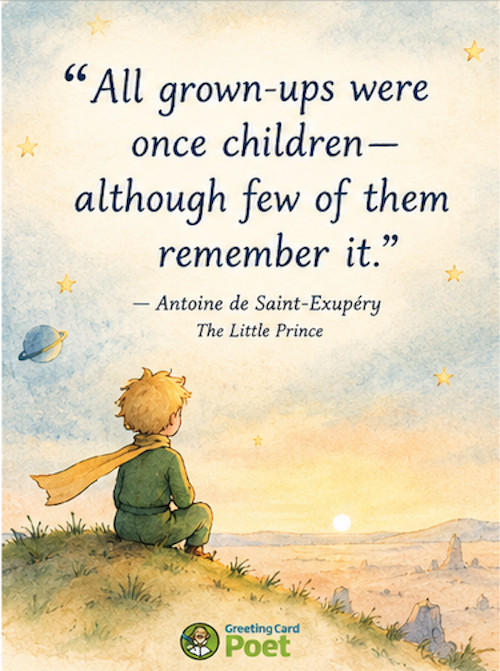
“All grown-ups were once children—although few of them remember it.”
—Antoine de Saint-Exupéry, dedication to Léon Werth
Discover our feature on really deep quotes.
If there’s a single line that captures the spirit of The Little Prince, this might be it.
Notice that Saint-Exupéry doesn’t simply remind us that adults were once children. That would be a remarkably unremarkable observation.
It’s the second half that makes the quotation unforgettable.
Most grown-ups have forgotten what childhood felt like.
We were curious. We loved exploring. And we asked outrageous questions and invented elaborate worlds. Our greatest concerns involved bicycle rides, recess, and whether somebody would let us have another cookie.
Then we grew older.
Mortgages replaced make-believe. Calendars replaced spontaneity. Somewhere along the way, many of us began confusing being responsible with being serious.
Saint-Exupéry isn’t suggesting that adults abandon their obligations. He’s reminding us that maturity doesn’t require surrendering imagination, curiosity, or joy.
The lesson: Grow older, certainly. Just don’t forget the child who made growing up such an interesting adventure.
2. What Matters Most Is Seen With the Heart
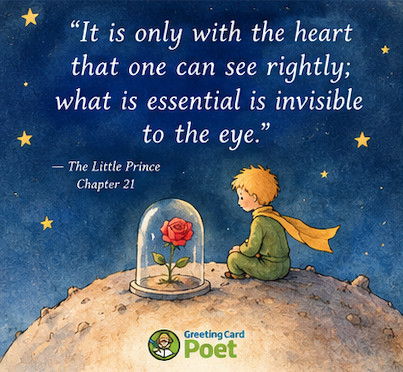
“It is only with the heart that one can see rightly; what is essential is invisible to the eye.”
—The fox, Chapter 21
This is arguably the book’s most famous philosophical insight.
The fox explains that appearances reveal only part of the truth.
You can see someone’s face, clothing, possessions, or accomplishments. But you cannot see their loyalty, kindness, generosity, or capacity to love.
Those qualities are discovered through experience.
The quotation is also a warning against judging people by superficial standards.
A modest home can contain extraordinary happiness. A person who rarely attracts attention may possess remarkable wisdom. And the greatest gift someone gives you may be something nobody else ever notices.
The lesson: Look beyond appearances. The most valuable things in life rarely come with price tags.
Explore our Shel Silverstein Quotes and Poems for more insights on life.
3. Love Becomes Important Through the Time We Give It
“It is the time you have wasted for your rose that makes your rose so important.”
—The fox, Chapter 21
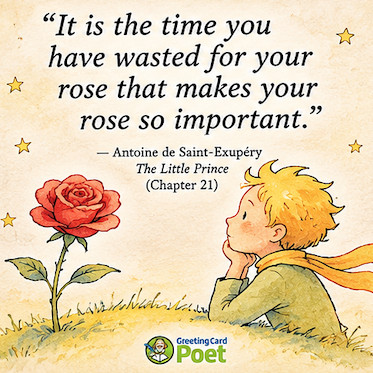
The fox is being deliberately provocative.
The prince hasn’t actually wasted time caring for his rose. The hours he spent watering, protecting, and listening to her are precisely what made their relationship meaningful.
In other words, love grows through attention.
Think about the people who mean the most to you.
They probably aren’t important because they possess extraordinary qualities nobody else has.
They’re important because of the birthdays, conversations, ordinary afternoons, adventures, disappointments, and memories you’ve shared.
Love isn’t measured by the grandness of a gesture.
Sometimes it’s measured by the number of times someone has quietly shown up.
The lesson: Time spent caring for someone is never truly wasted.
Browse our Funny Sayings About Life.
4. Relationships Create Responsibilities
“You become responsible, forever, for what you have tamed.”
—The fox, Chapter 21
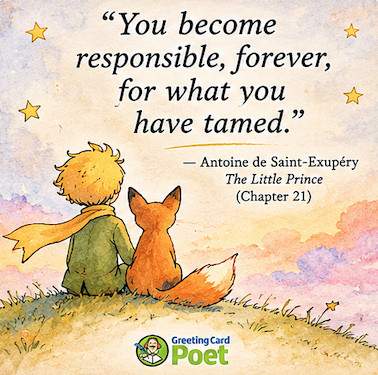
In the fox’s language, taming means establishing a meaningful bond.
Before the prince befriends him, the fox is simply one animal among thousands. Afterward, they matter to each other.
That connection creates responsibilities.
Friendship involves more than enjoying someone’s company. Love requires more than pleasant feelings.
Both demand care, consideration, and trust.
The passage doesn’t mean that we must remain in harmful relationships. It means that meaningful bonds deserve respect, healthy boundaries, and thoughtful treatment.
The lesson: Don’t take the people who trust you for granted.
5. We Often Forget What We’re Looking For
In Chapter 22, the prince encounters a railway switchman who sends trains full of people rushing from one destination to another.
The passengers are constantly moving, yet few seem satisfied with where they’re going.
The prince notices something the adults have overlooked: Children often know exactly what they want.
A favorite toy. A friend. A little attention.
Adults, meanwhile, can become so busy pursuing the next accomplishment that they forget why they’re pursuing it.
The lesson: Before rushing toward your next destination, make sure it’s somewhere you actually want to go.
6. Love Makes Someone Irreplaceable
When the prince discovers a garden containing thousands of roses, he’s devastated.
He believed his own rose was unique.
The fox eventually helps him understand that his flower’s importance doesn’t depend on her being the only rose in existence.
She’s special because of their relationship.
She’s the flower he has cared for, worried about, and come to love.
That’s why a person can be irreplaceable even in a world containing billions of people.
The lesson: We become special to one another through love and shared experiences, not through comparison.
7. Friendship Cannot Be Bought
In Chapter 21, the fox observes that people have become accustomed to purchasing things rather than taking time to understand them.
Unfortunately, friendship isn’t something that can be bought ready-made.
This observation feels remarkably modern.
We can order groceries, arrange transportation, and communicate with people across the globe in seconds.
But genuine friendship still requires patience, trust, shared experiences, and attention.
You cannot purchase a lifelong friend with overnight delivery.
Not even with free shipping.
The lesson: Real friendship is something you build, not something you acquire.
8. Imagination Helps Us Recognize Possibilities
At the beginning of the book, the narrator recalls drawing a boa constrictor that had swallowed an elephant.
Adults assume his drawing depicts a hat.
Their inability to understand discourages him from becoming an artist.
It’s a funny scene with a surprisingly serious message.
Adults often interpret everything through familiar categories. Children are more willing to imagine what might exist beyond appearances.
The lesson: Don’t become so practical that you lose the ability to see possibilities other people overlook.
9. Friendship Is Worth the Risk of Heartbreak
The fox knows that saying goodbye to the prince will make him cry.
Nevertheless, he wants their friendship.
Why?
Because knowing the prince will enrich his life, even after they separate.
The fox understands something adults sometimes resist acknowledging: Loving someone makes us vulnerable.
But refusing meaningful relationships to avoid future sadness would mean missing much of life’s greatest happiness.
The lesson: A friendship doesn’t become less valuable because its eventual ending may hurt.
10. Beauty Often Comes From What We Cannot See
While crossing the desert, the prince suggests that its beauty comes partly from the possibility of a hidden well.
The empty landscape becomes meaningful because it may contain something precious.
It’s a beautiful metaphor for hope.
A place, person, or experience may hold value that isn’t immediately apparent.
Sometimes the most wonderful discoveries require patience and a willingness to look beneath the surface.
The lesson: The world contains more beauty than our eyes can immediately recognize.
Quotes About Love and Romance
The little prince’s relationship with his rose is charming, frustrating, tender, and complicated.
Pretty much like human romance, except with more gardening.
11. Love Isn’t Always Easy to Understand
In Chapter 8, the prince remembers how his rose’s vanity, demands, and contradictory behavior confused him.
Although he adored her, he struggled to understand the affection beneath her dramatic personality.
Later, he recognizes that her words shouldn’t have mattered more than the tenderness she showed him.
The meaning: People sometimes express love imperfectly. Understanding someone requires looking beyond pride, insecurity, and occasional foolishness.
12. Sometimes We Appreciate Love Too Late
The prince eventually regrets leaving his rose.
He realizes that he was inexperienced and didn’t understand how to love her properly.
That’s one of the book’s most moving admissions.
Love sometimes becomes clearer with maturity.
The qualities that once irritated us may eventually become part of what we miss.
The meaning: Appreciate the people who love you while you still have opportunities to demonstrate your affection.
13. Saying Goodbye Can Reveal Hidden Feelings
In Chapter 9, as the prince prepares to leave, the rose finally admits her love.
She also accepts some responsibility for their misunderstandings.
It’s a touching moment because both characters become more honest just as they’re separating.
How often do human beings do something similar?
We postpone important conversations until circumstances make them unavoidable.
The meaning: Don’t wait for goodbye to say what someone needs to hear today.
14. Real Love Isn’t a Beauty Contest
The prince’s encounter with the rose garden provides one of the story’s most powerful lessons about romance.
His flower isn’t unique because she’s more beautiful than every other rose.
She’s unique because she’s his beloved companion.
Their relationship has created a history no other flower shares.
The meaning: Lasting love depends less on finding a flawless person than on creating an extraordinary relationship with a real one.
15. Everyday Acts Can Be Expressions of Love
The prince remembers watering his rose, shielding her from drafts, and protecting her from caterpillars.
These tasks may appear insignificant.
But together they represent devotion.
Anyone can claim to care about another person. The more meaningful question is what that care looks like in everyday life.
The meaning: Love frequently speaks through small gestures rather than grand declarations.
16. Loving Someone Makes Their Troubles Matter
The prince becomes upset when the pilot treats his concern about flowers and sheep as unimportant.
To the pilot, these concerns seem trivial compared with repairing his aircraft.
To the prince, the safety of his rose matters enormously.
The scene reminds us that love changes our priorities.
A problem involving someone we cherish may feel more urgent than an objectively larger problem elsewhere.
The meaning: Caring means taking another person’s concerns seriously, even when they seem small to us.
17. Love Requires More Than Good Intentions
The prince and his rose care deeply for one another, yet both contribute to their difficulties.
The rose hides affection behind pride. The prince responds with frustration and misunderstanding.
Their story recognizes that loving someone and understanding how to love them aren’t necessarily the same thing.
The meaning: Affection becomes stronger through patience, honest communication, forgiveness, and emotional maturity.
A little less drama wouldn’t hurt, either.
Friendship and Meaningful Connections Quotes
The fox may be the most perceptive friendship counselor in children’s literature.
He charges nothing, offers excellent advice, and doesn’t insist that the prince begin keeping a gratitude journal.
18. Friendship Changes Two Lives
The fox explains that before two strangers develop a relationship, they are simply unfamiliar individuals.
Once they establish a bond, each becomes special to the other.
It’s an elegant description of friendship.
Think about your closest friends.
There was once a time when you didn’t know they existed.
Now it’s difficult to imagine your life without them.
The meaning: Friendship transforms ordinary strangers into people who matter enormously.
19. Friendship Requires Patience
In Chapter 21, the fox tells the prince that establishing a bond takes time.
He must approach gradually, allowing familiarity and trust to develop.
It’s an especially useful lesson in our impatient world.
Friendships don’t always arrive fully formed.
Often they begin with small conversations, shared interests, and repeated moments of kindness.
The meaning: Lasting relationships develop through consistency, not speed.
20. Anticipation Is Part of Happiness
The fox explains that knowing when the prince will visit allows him to begin enjoying the occasion before it happens.
The hours leading up to their meeting become special.
Anyone who has looked forward to seeing an old friend understands this feeling.
Friendship makes both the reunion and the anticipation enjoyable.
The meaning: People who matter to us enrich our lives even when we’re simply looking forward to seeing them.
21. Friends Change How We Experience the World
The fox tells the prince that golden wheat fields will remind him of the boy’s golden hair.
Something previously ordinary becomes meaningful because of their friendship.
That’s a surprisingly accurate description of memory.
A favorite song reminds us of an old friend. A familiar restaurant recalls a wonderful evening. A particular season brings back someone we’ve loved.
The meaning: Meaningful relationships transform ordinary places and experiences into lasting reminders of affection.
22. Words Can Create Misunderstandings
“Words are the source of misunderstandings.”
—The fox, Chapter 21
The fox isn’t arguing that people should stop talking.
He’s explaining that closeness requires more than conversation.
Sometimes trust develops through presence, patience, and simply spending time together.
Words can help us connect, but they can also become confusing when we misread intentions or overlook feelings.
Anyone who has argued about the meaning of a text message knows exactly what he means.
The lesson: Communicate thoughtfully, but remember that kindness and consistency often speak louder than words.
23. Being Surrounded by People Doesn’t Prevent Loneliness
The prince encounters the snake in the desert and wonders about the absence of people.
The snake suggests that loneliness isn’t limited to empty places.
It’s a profound observation.
Someone can feel isolated in a crowded city, surrounded by colleagues, or sitting among hundreds of strangers.
Connection requires more than physical proximity.
The meaning: One genuine relationship can provide more companionship than a room full of superficial acquaintances.
24. Shared Experiences Create Unexpected Friendships
The friendship between the pilot and the prince develops under extraordinary circumstances.
One is a practical adult struggling to repair an airplane. The other is a curious child from a distant planet.
They have little in common.
Yet their conversations, disagreements, laughter, and eventual search for water create a powerful bond.
The meaning: Friendship doesn’t require identical backgrounds or personalities. Sometimes it begins when two people simply make time to understand one another.
Little Prince Quotes About Growing Up, Childhood, and Imagination
Saint-Exupéry clearly enjoyed poking fun at adults.
Judging by the characters in his book, he had plenty of material.
25. Adults Don’t Always Understand What’s Important
The narrator recalls how grown-ups dismissed his childhood drawing because they couldn’t recognize what it represented.
The scene establishes one of the book’s central concerns.
Adults often become so committed to conventional thinking that they overlook imagination and wonder.
The meaning: Age may bring experience, but it doesn’t guarantee understanding. Sometimes children recognize truths adults have forgotten.
26. Numbers Cannot Measure Everything
In Chapter 4, the narrator describes how adults prefer facts such as ages, prices, and measurements.
They may pay more attention to the cost of a house than to the qualities that make it beautiful.
Saint-Exupéry isn’t criticizing useful information.
He’s criticizing the assumption that everything meaningful can be expressed numerically.
The meaning: A person’s value cannot be calculated from possessions, accomplishments, or statistics.
27. Small Problems Become Dangerous When Neglected
The prince explains how young baobab trees must be removed before they grow large enough to threaten his tiny planet.
It’s an excellent metaphor for life’s neglected problems.
Resentment, dishonesty, poor habits, and procrastination often begin quietly.
Left unattended, they can become surprisingly difficult to manage.
The meaning: Address problems while they’re manageable instead of waiting until they threaten everything around them.
28. Wisdom Begins With Judging Ourselves Fairly
In Chapter 10, the king explains that evaluating oneself accurately is more difficult than judging others.
It’s one of the rare moments when an otherwise ridiculous adult offers genuinely useful advice.
Human beings are remarkably talented at identifying everybody else’s shortcomings.
Recognizing our own requires greater humility.
The meaning: True wisdom involves honest self-examination rather than constant criticism of others.
29. Constantly Seeking Praise Is Exhausting
The conceited man wants the prince to admire him.
He has little interest in anything that doesn’t reinforce his own importance.
It’s a wonderfully exaggerated portrait of vanity.
But beneath the humor lies an uncomfortable truth.
Seeking admiration isn’t the same as building meaningful relationships.
The meaning: A life devoted to applause can become surprisingly lonely.
30. Possessing Something Isn’t the Same as Enjoying It
The businessman believes he owns the stars because he has counted them.
He spends his days calculating his astronomical holdings.
Unfortunately, he seems too busy to appreciate the beauty of what he supposedly possesses.
Saint-Exupéry’s criticism remains relevant in a world fascinated by wealth, rankings, and accumulating more.
The meaning: Having more doesn’t necessarily mean enjoying life more.
Sometimes the person gazing at the stars is richer in experience than the person claiming to own them.
31. Saving Time Doesn’t Automatically Improve Life
The prince meets a merchant selling pills that supposedly eliminate the need to drink water.
The invention saves people time.
But the prince would rather spend those minutes walking leisurely toward a fountain.
It’s a delightful challenge to our obsession with efficiency.
Technology can save time, but what matters is how we use the time we’ve gained.
The meaning: Don’t become so efficient that you eliminate the very experiences that make life enjoyable.
Little Prince Quotes About Goodbye, Grief, and Remembering Loved Ones
The final chapters of The Little Prince are gentle, mysterious, and deeply emotional.
They offer especially meaningful reflections on separation, memories, and the enduring influence of love.
32. Sadness Is Personal and Difficult to Explain
“It is such a secret place, the land of tears.”
—The narrator, Chapter 7
This beautiful observation comes after the prince becomes distressed about his beloved flower.
The pilot recognizes that another person’s sorrow can be difficult to understand from the outside.
Grief is intensely personal.
Two people may experience similar losses and respond in completely different ways.
The passage reminds us not to assume that someone’s sadness should follow our expectations.
The lesson: Treat another person’s pain with tenderness, even when you don’t fully understand it.
33. Memories Can Transform the Night Sky
Near the end of the story, the prince tells the pilot that the stars will remind him of his laughter.
Ordinary stars will become a personal connection to their friendship.
It’s among the book’s most comforting images.
A familiar place, song, photograph, or evening sky can become meaningful because it reminds us of someone we love.
The meaning: Memories give ordinary things extraordinary emotional value.
34. Friendship Can Outlast Separation
The prince understands that leaving will bring the pilot sadness.
Yet he also suggests that the pilot will eventually find comfort in having known him.
Their friendship won’t become meaningless simply because they are apart.
It’s a moving idea for farewells, long-distance friendships, and messages of remembrance.
The meaning: The value of a relationship isn’t measured solely by how long two people remain together.
35. Love Makes Us Care About What Happens Next
The book ends with the pilot wondering whether the prince’s sheep might have eaten his rose.
The uncertainty matters enormously to him.
To anyone unfamiliar with the story, the fate of a single flower might seem insignificant.
But to the pilot, that flower represents the prince’s love, hopes, and happiness.
It’s a beautiful conclusion because the narrator has learned to care about something that once might have seemed unimportant.
The meaning: Love changes what we notice, what we worry about, and what we consider precious.
Seven Life Lessons Adults Can Learn From The Little Prince
The beauty of Saint-Exupéry’s story is that its wisdom extends far beyond literature.
Here are seven lessons we can put into practice.
1. Never Forget the Child You Once Were
This may be the book’s most important message.
Growing older is inevitable. Losing your curiosity isn’t.
Keep discovering things. Ask questions. Be willing to look ridiculous occasionally.
The world doesn’t become less interesting as we age.
Sometimes we simply stop paying attention.
2. Make Time for the People You Love
The prince’s relationship with his rose reminds us that time is one of love’s most meaningful gifts.
Make the phone call. Arrange the visit. Remember the birthday.
Nobody reaches the end of life wishing they’d spent more evenings admiring their email inbox.
3. Look Beyond Appearances
People are more than their clothing, possessions, accomplishments, and social standing.
Kindness, loyalty, compassion, and integrity often reveal themselves slowly.
The fox’s advice is a reminder that meaningful judgments require more than a quick glance.
4. Choose Connection Over Possessions
The businessman owns stars but doesn’t appreciate them.
The fox possesses little yet understands friendship.
The contrast is unmistakable.
Success and financial security are worthwhile goals, but neither automatically produces happiness.
Relationships frequently provide the richest rewards.
5. Accept That Love Includes Vulnerability
The rose, the fox, and the pilot all experience uncertainty because they care about someone.
Meaningful relationships expose us to worry and disappointment.
They also give us joy, belonging, and memories.
Avoiding affection to prevent sadness would be a terribly expensive bargain.
6. Find Joy in Ordinary Experiences
A walk toward a fountain. A beautiful sunset. The sound of a friend’s laughter.
Saint-Exupéry repeatedly celebrates experiences that cost little or nothing.
Happiness doesn’t always announce itself with fireworks.
Sometimes it’s sitting quietly beside someone you love.
7. Remember That Responsibility and Wonder Can Coexist
The prince carefully tends his planet while remaining curious about the universe.
That’s a useful model for adulthood.
Pay your bills. Keep your promises. Take your responsibilities seriously.
Then make room for laughter, adventure, imagination, and the occasional wonderfully impractical idea.
A person can be dependable without becoming dull.
15 Little Prince-Inspired Messages for Greeting Cards
One reason The Little Prince remains so popular is that its themes naturally lend themselves to greeting cards.
Love, friendship, gratitude, encouragement, birthdays, and farewell messages all connect with the book’s wisdom.
Rather than reproducing passages, you can write an original message inspired by the story’s themes.
Here are 15 examples.
All messages below are original writing, not quotations from The Little Prince.
Romantic Love and Anniversary Messages
- “Of all the planets in the universe, I’m awfully glad we landed on the same one. Loving you has made my world extraordinary.”
- “What makes our love special isn’t that every day is perfect. It’s that we’ve filled ordinary days with extraordinary memories.”
- “I could explore a thousand galaxies and still know that my favorite place is wherever you are.”
Friendship Messages
- “Some people make the world bigger through their adventures. Others make it brighter simply by being part of your life. You’ve done both.”
- “Our friendship proves that the best things in life aren’t things at all. They’re people who make ordinary days unforgettable.”
- “Somewhere between all our conversations, laughter, and ridiculous adventures, you became one of my favorite people on the planet.”
Birthday Messages
- “Here’s to another year of curiosity, laughter, wonderful discoveries, and remembering that growing older doesn’t mean growing boring.”
- “May your birthday remind you that the universe is still filled with surprises, possibilities, and reasons to act like a kid.”
- “Another journey around the sun! May you collect more memories than possessions and more friends than candles.”
Goodbye and Farewell Messages
- “Distance may change how often we see each other, but it won’t change the wonderful memories we’ve made.”
- “Some people pass through our lives. Others change the way we see the world. You’ll always be one of the latter.”
- “Wherever your next adventure takes you, remember that you’ve left a little happiness behind with everyone who knows you.”
Sympathy and Remembrance Messages
- “The love you shared doesn’t disappear. It lives in the memories, kindness, and beautiful moments that remain.”
- “May the little reminders of someone you love—a familiar song, a favorite place, a beautiful evening—bring comfort when you need it most.”
- “A wonderful life leaves more than memories. It leaves love that continues to shape the people who were fortunate enough to share it.”
How to Make These Messages More Personal
The secret is adding a specific memory.
Instead of simply telling someone they’ve made your life brighter, mention the unexpected kindness they showed you, the trip you’ll never forget, or the afternoon you laughed until your sides hurt.
A single personal detail can transform a pleasant greeting into something meaningful.
And that’s entirely consistent with the fox’s philosophy.
Relationships become special through attention.
Your greeting cards should, too.
Frequently Asked Questions About The Little Prince Quotes
What is the most famous Little Prince quote?
The most famous quotation is generally the fox’s explanation in Chapter 21 that genuine understanding comes through the heart and that life’s essential qualities cannot be recognized merely through sight.
It’s especially popular because it captures the book’s central message about love, friendship, and emotional understanding.
What does the quote about grown-ups remembering childhood mean?
Saint-Exupéry suggests that adults frequently lose touch with the imagination, curiosity, simplicity, and wonder they experienced as children.
The quotation doesn’t criticize growing older.
Instead, it questions why so many people abandon valuable childhood qualities as they mature.
Its placement in the dedication makes it especially significant: The author dedicates the book to his adult friend Léon Werth, but ultimately addresses the child his friend once was.
What does The Little Prince teach about love?
The book suggests that love becomes meaningful through attention, time, responsibility, patience, and shared experiences.
The prince’s relationship with his rose illustrates how emotional attachment makes someone special.
It also recognizes that love can involve misunderstanding, pride, vulnerability, and regret.
What does the fox represent in The Little Prince?
The fox represents friendship, wisdom, emotional connection, and the responsibilities that accompany meaningful relationships.
His conversations with the prince help explain why we become attached to certain people and why those relationships matter.
The fox also understands that loving someone may eventually bring sadness, but believes the connection is worthwhile.
Why is the rose so important?
The rose represents the prince’s love and emotional attachment.
Although she isn’t physically unique, she becomes irreplaceable because of the time, care, and affection the prince has given her.
Her importance comes from their relationship rather than her appearance.
What does The Little Prince say about growing older?
The book questions the assumption that adulthood automatically brings wisdom.
Its grown-up characters frequently become consumed by money, power, admiration, or routine.
The prince, meanwhile, asks simple questions that reveal the absurdity of their priorities.
The underlying message is that maturity should include responsibility without sacrificing imagination, kindness, and curiosity.
Is The Little Prince a sad book?
Yes, although it’s also funny, hopeful, and deeply affectionate.
The story explores loneliness, separation, vulnerability, and the possibility of loss.
Its ending is deliberately mysterious and can be interpreted in different ways.
Many readers find it especially moving because it recognizes that meaningful relationships involve both happiness and sadness.
Can Little Prince quotes be used in wedding or anniversary cards?
The book’s reflections on love, devotion, and emotional connection are well suited to wedding and anniversary messages.
Select a passage that reflects the relationship, verify the wording and attribution, and consider adding a personal message explaining why it matters.
An original message inspired by the book can be even more meaningful because it allows you to speak directly to the recipient.
Are Little Prince quotes appropriate for sympathy cards?
Some of the book’s passages about memory, separation, and affection can offer comfort during grief.
Its imagery involving the stars is especially meaningful.
However, sympathy cards should acknowledge someone’s loss rather than attempt to explain it away.
A gentle message expressing love, remembrance, and support is usually the most appropriate choice.
Why do Little Prince quotes sometimes appear with different wording?
The Little Prince was originally written in French.
Katherine Woods produced the original English translation in 1943, and Richard Howard published another well-known English translation in 2000.
Different translations use different words to communicate the same underlying ideas.
For accurate attribution, identify the translation being quoted and verify the wording against that edition.
Final Thoughts: The Little Prince Is Really a Book About Remembering
Perhaps the most extraordinary thing about The Little Prince is that it doesn’t ask us to become different people.
It asks us to remember who we used to be.
Remember when the world seemed filled with possibilities? When making a friend was more important than impressing a stranger? When an ordinary sunset could stop us in our tracks?
Saint-Exupéry understood that adulthood has a way of complicating things.
We acquire responsibilities, pursue success, accumulate possessions, and occasionally forget what any of it was supposed to accomplish.
Then along comes a little boy from a distant planet to remind us.
Love matters. Friendship matters. Kindness matters.
And wonder isn’t something we’re supposed to outgrow.
The little prince’s greatest gift may be his ability to show adults what they’ve forgotten.
And perhaps, every once in a while, to stop worrying about the grown-up world long enough to draw a sheep.
By Michael O’Halloran

Michael O’Halloran founded Greeting Card Poet in 2014 and has worked as its publisher and editor ever since. He has co-authored four books on kids’ trivia and four on coaching. Previously, Michael was the president of Magnetic Poetry. He has invented and brought to market over 75 new gift and toy products, most of which involve wordplay. Mike is married and a father of four daughters.
You are on our 35 Best The Little Prince Quotes About Love, Friendship & Life feature.
You might also like:
