
Email Closings
You can spend 20 minutes crafting the perfect email, reread it six times, eliminate every unnecessary comma, and then arrive at the final two words:
Best regards?
Suddenly, everything grinds to a halt.
Is “Regards” too cold? Is “Warm regards” too warm? Does “Cheers” make you sound friendly or like you’re sitting in a London pub? Can you simply write “Thanks”? And what exactly is the difference between “Best,” “All the best,” and “Best wishes”?
Welcome to the surprisingly complicated world of email closings.
The good news is that figuring out how to end an email doesn’t have to require a committee meeting. The best email sign-off usually depends on three things: whom you’re emailing, why you’re emailing them, and how well you know them.
A note to your boss deserves a different ending from an email to your brother. A first message to a potential client shouldn’t end the same way as your 47th email to a coworker who sits 12 feet away.
Below are more than 150 email closing lines and email sign-offs, organized by situation. Whether you need something professional, friendly, funny, appreciative, casual, or appropriate for someone you’ve never met, there’s an ending here that should fit.
What Is an Email Closing?
An email closing is the final portion of your message. In most cases, a good email ending has three parts:
- A final sentence or email closing line
- A short email sign-off
- Your name and, when appropriate, your email signature
For example:
I appreciate your taking the time to review the proposal. Please let me know if you have any questions.
Best regards,
Alex
“Please let me know if you have any questions” is the closing line.
“Best regards” is the sign-off.
Simple enough.
The trick is choosing an ending that matches the tone of everything that came before it.
Ending a serious job-application email with “Later!” would be memorable, although probably not for the reason you hoped.
The Best Email Closings for Almost Any Situation
If you’re standing at your keyboard suffering from sign-off paralysis, start here.
These are among the most versatile email closings because they work in a wide variety of professional and personal situations:
- Best
- Best regards
- Kind regards
- Regards
- Thanks
- Thank you
- Thanks again
- All the best
- Best wishes
- Warm regards
- With appreciation
- Take care
- Have a great day
- Have a great week
- Looking forward to hearing from you
Of those, Best regards may be the Swiss Army knife of professional email closings.
It’s polite without being stiff.
Friendly without becoming familiar.
Professional without sounding as though your email was dictated by a lawyer in 1957.
When in doubt, it’s difficult to go terribly wrong with it.
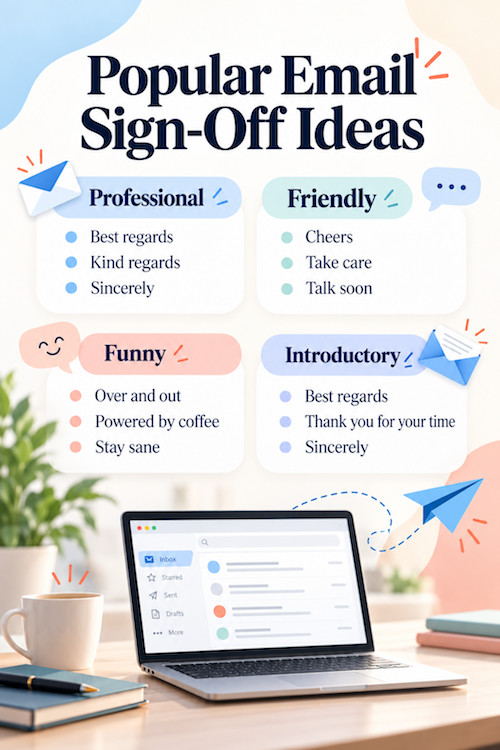
Professional Email Closings
Professional email closings should do one thing particularly well:
Get out of the way.
You generally don’t want the recipient thinking, “Interesting choice of sign-off.”
You want the recipient thinking about your proposal, question, application, meeting, or next step.
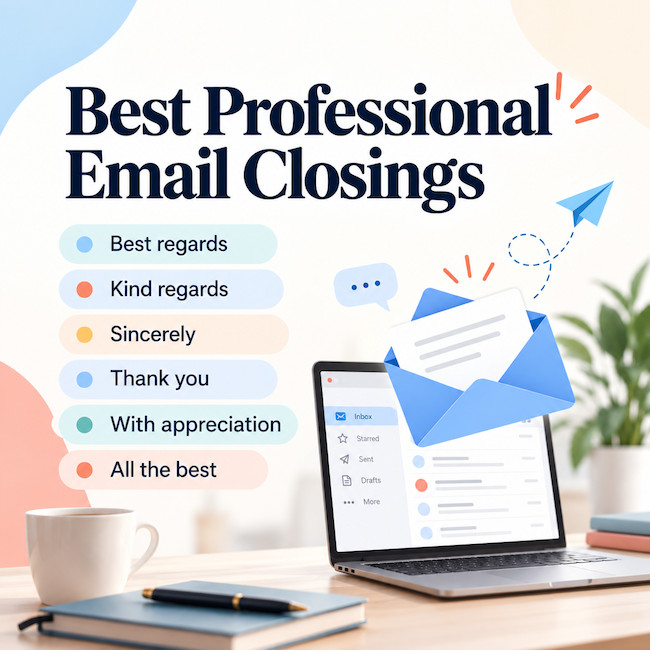
Best Professional Email Sign-Offs
Try these for clients, managers, vendors, business contacts, prospective employers, and other professional correspondence:
- Best regards
- Kind regards
- Sincerely
- Regards
- Best
- Thank you
- Many thanks
- With appreciation
- With gratitude
- Respectfully
- Warm regards
- All the best
- Best wishes
- Thank you for your time
- Thank you for your consideration
- Thanks again
- Much appreciated
- With thanks
- Cordially
- Yours sincerely
Discover our Best New Beginnings Messages.
Which Professional Email Closing Should You Use?
Best regards is an excellent all-purpose business sign-off.
Kind regards feels slightly warmer while remaining professional.
Sincerely works particularly well for formal correspondence, applications, official requests, and introductory emails.
Regards is short and businesslike, although it can come across as a little cooler.
Best is concise and modern. It works especially well once you already have a relationship with the recipient.
Thank you is ideal when the recipient is helping you with something.
Respectfully is best saved for genuinely formal situations or correspondence involving hierarchy or authority. Using it to ask Gary in accounting whether he received your expense report may be excessive.
Professional Email Closing Lines
Remember that your sign-off isn’t the entire ending. The sentence immediately before it may be even more important.
Strong professional email closing lines include:
- Please let me know if you have any questions.
- I look forward to hearing your thoughts.
- I appreciate your time and consideration.
- Thank you for taking the time to review this.
- I look forward to discussing this further.
- Please let me know how you’d like to proceed.
- I’m happy to provide any additional information.
- Let me know if there’s anything else you need from me.
- I appreciate your help with this.
- I look forward to speaking with you.
- Please feel free to reach out with any questions.
- I’ll watch for your response.
- I hope we have an opportunity to work together.
- Thank you again for your assistance.
- I look forward to our conversation on Thursday.
A good rule: If there’s a clear next step, put it in the closing line rather than hoping “Best regards” somehow communicates it telepathically.
How to End an Email to Someone You Don’t Know Well
First impressions matter, particularly when the person receiving your email has absolutely no idea who you are.
For an introductory email, aim for friendly professionalism.
Too casual can feel presumptuous.
Too formal can sound like you’re requesting an audience with the king.
Email Sign-Offs for a First Introduction
Good choices include:
- Best regards
- Kind regards
- Sincerely
- Best
- Thank you
- Thank you for your time
- Thank you for your consideration
- With appreciation
- All the best
- Best wishes
- Warm regards
- Respectfully
- Looking forward to connecting
- Looking forward to speaking with you
- I appreciate your consideration
Introductory Email Closing Lines
Try:
- I’d welcome the opportunity to speak with you.
- I hope we have a chance to connect.
- Thank you for taking the time to read my note.
- I’d be happy to provide additional information.
- I look forward to learning more about your work.
- I hope we can continue the conversation.
- Please let me know if you’d be open to a brief call.
- I’d appreciate the opportunity to discuss this further.
- Thank you for considering my request.
- I look forward to hearing from you.
The secret here is not trying too hard.
You are introducing yourself, not proposing marriage.
Friendly Email Closings
Once you know someone, you have more room to sound like an actual human being.
These friendly email closings work well with colleagues, longtime clients, friends, acquaintances, neighbors, fellow volunteers, and anyone else with whom you’ve established a comfortable relationship.
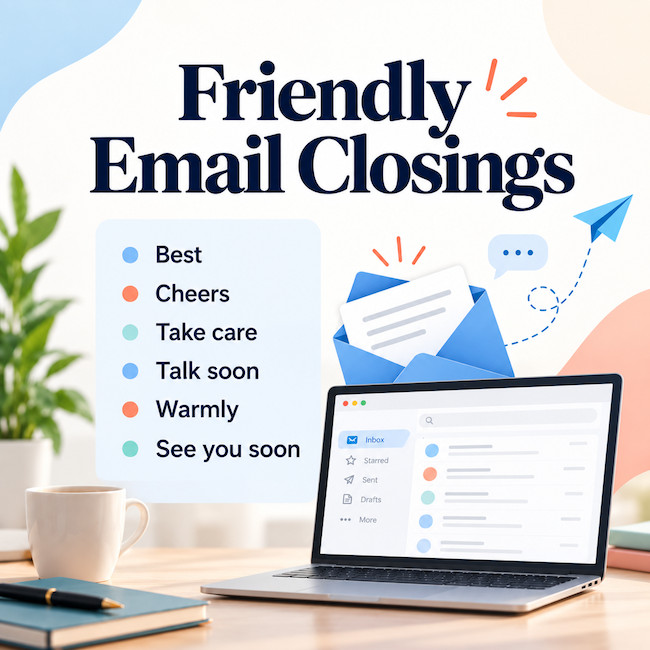
Friendly Email Sign-Offs
- Best
- All the best
- Best wishes
- Cheers
- Thanks
- Thanks again
- Take care
- Talk soon
- See you soon
- Until next time
- Warmly
- Warm wishes
- Have a great day
- Have a good one
- Have a great weekend
- Enjoy your weekend
- Have a great week
- Enjoy the rest of your day
- Catch you later
- Looking forward to it
- More soon
- Until then
- Stay well
- Be well
- Wishing you well
Chummy Closing Lines
Add a little personality with:
- Hope you have a terrific weekend.
- Looking forward to catching up soon.
- It was great hearing from you.
- Hope all is well on your end.
- Thanks again for everything.
- Let’s catch up again soon.
- Looking forward to seeing you.
- Enjoy the rest of your week.
- I hope things are going well.
- Keep me posted.
- Let me know how it turns out.
- Hope to see you soon.
- Take good care.
- Safe travels.
- Enjoy the weekend—you’ve earned it.
That last one works especially well on Friday afternoon, when everyone has mentally left the building anyway.
Casual Email Sign-Offs
Not every email needs to wear a necktie.
For coworkers, friends, family members, and other people you know well, casual email closings can make communication feel more natural.
Try:
- Thanks
- Cheers
- Best
- Later
- Take care
- Talk soon
- See you
- See ya
- Have a good one
- Enjoy
- Until next time
- Catch you later
- More soon
- Be well
- Stay well
- Onward
- Keep in touch
- Appreciate it
- You’re the best
- Have fun
- Safe travels
“Cheers” deserves special mention.
In some countries it’s practically punctuation. In others, it can make you sound as though you’re raising an invisible pint.
Still, between people who know each other, it’s warm, brief, and useful.
Funny Email Sign-Offs
A funny email closing can be memorable.
It can also make your boss wonder whether you’ve finally snapped.
Know your audience.
Funny email sign-offs work best with friends, close coworkers, creative teams, and people who already understand your sense of humor.
They are generally not recommended when writing to:
- A potential employer
- The IRS
- Your attorney
- Someone you are firing
- Someone firing you
- The person deciding whether to approve your mortgage
With everyone else, proceed carefully.
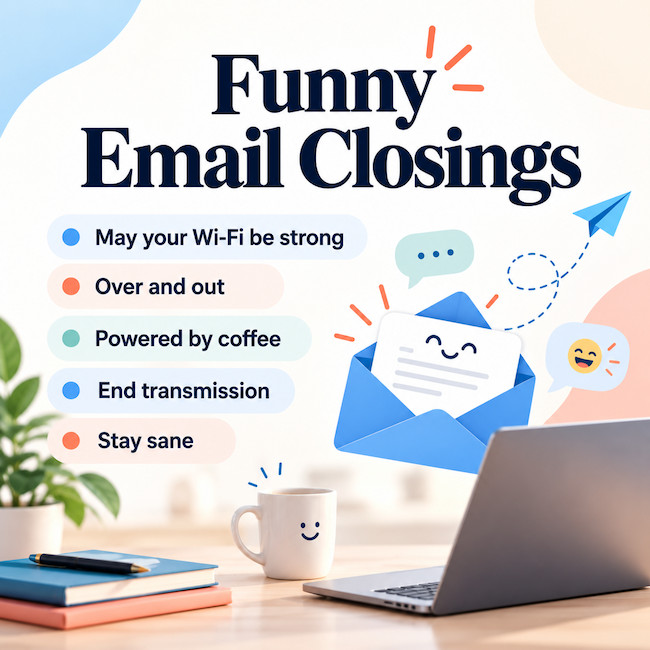
Funny Email Closings for Coworkers and Friends
- May the inbox be ever in your favor
- Surviving one email at a time
- Yours in email overload
- Sent with minimal caffeine remaining
- Until the next unnecessary meeting
- Another email successfully completed
- Over and out
- Stay sane
- Keep fighting the good fight
- Off to my next Zoom
- Yours in procrastination
- Professionally yours, more or less
- With guarded optimism
- Still typing
- Awaiting Friday
- Counting down to the weekend
- Powered by coffee
- Fueled by caffeine and deadlines
- Sent from somewhere near my desk
- May your meetings be short
- May your Wi-Fi be strong
- Inbox zero is a myth
- Ctrl + Alt + Goodbye
- To be continued…
- That’s all, folks
- End transmission
- Live long and prosper
- Keep calm and delete emails
- See you in the next thread
- Your humble email servant
- With more enthusiasm than this meeting deserves
- From the department of getting things done
- Back to pretending I have inbox zero
- Yours until my next notification
- Another crisis narrowly avoided
The trick to funny email endings is restraint.
If your sign-off is funnier and longer than the email itself, the tail may be wagging the dog.
Warm Email Closings
Sometimes “Best” feels too cold, but “Love” feels like you’re about to announce something.
Enter the warm sign-off.
These are particularly good when expressing encouragement, gratitude, sympathy, congratulations, or genuine personal connection.
Warm Email Sign-Off Ideas
- Warm regards
- Warmest regards
- Warm wishes
- Warmly
- With warm wishes
- All the best
- Wishing you the best
- Best wishes
- Take care
- With gratitude
- With appreciation
- Thinking of you
- Wishing you well
- Stay well
- Be well
- With heartfelt thanks
- Gratefully
- With many thanks
Be aware that warmth depends heavily on context.
“Warmly” from someone you’ve exchanged two emails with may seem perfectly pleasant.
“Warmly” at the bottom of a message that says, “Your account is 120 days overdue and has been forwarded to collections,” creates a somewhat different mood.
Email Closings That Say Thank You
Gratitude is one of the easiest ways to finish an email naturally.
If someone has given you information, taken action, answered a question, provided a referral, reviewed something, or otherwise helped, say thanks.
Revolutionary concept, we know.
Thank-You Email Sign-Offs
- Thank you
- Thanks
- Thanks again
- Many thanks
- Much appreciated
- With thanks
- With appreciation
- With gratitude
- Gratefully
- My thanks
- Thanks for your help
- Thank you for your time
- Thank you for your consideration
- Thank you for your assistance
- Thanks for taking a look
- I appreciate it
- I appreciate your help
Appreciation Closing Lines
- I really appreciate your help with this.
- Thank you for taking the time.
- I appreciate your getting back to me.
- Thanks for pointing me in the right direction.
- Your help means a lot.
- I appreciate your willingness to help.
- Thanks again for making this easier.
- I’m grateful for your input.
- Thank you for giving this your attention.
- I sincerely appreciate your support.
One caution: “Thanks in advance” can sometimes sound as though you have already volunteered the recipient for whatever favor you’re asking.
If the request is substantial, “Thank you for considering it” is often gentler.
How to End an Email When You Want a Response
Sometimes the point of the email is not simply to deliver information.
You need the other person to do something.
In that case, your final line should make the next step unmistakably clear.
Email Closing Lines That Encourage a Response
- Please let me know what you think.
- I’d appreciate your thoughts.
- Let me know which option you prefer.
- Please let me know if that works for you.
- Does Thursday afternoon work on your end?
- Let me know if you’d like to move forward.
- Please send me your feedback when you have a chance.
- I’d welcome your input.
- Let me know if I can answer any questions.
- Please let me know how you’d like to proceed.
- I look forward to hearing from you.
- I’m interested to hear your perspective.
- Let me know which direction you’d recommend.
- Please confirm when you have a moment.
- I’d appreciate a response by Friday if possible.
Specificity generally beats vagueness.
“Can you approve this by Thursday?” is considerably more useful than “Thoughts?”
Although “Thoughts?” does have the advantage of requiring only eight keystrokes.
Email Closings for Job Applications
Few situations call for polished professionalism more than applying for a job.
This is not the place to debut your hilarious new sign-off, “May your Wi-Fi be strong.”
Keep it confident, appreciative, and concise.
Good Job Application Sign-Offs
- Sincerely
- Best regards
- Kind regards
- Respectfully
- Thank you
- Thank you for your consideration
- With appreciation
- Best
- All the best
Job Application Closing Lines
- Thank you for considering my application.
- I would welcome the opportunity to discuss the position further.
- I look forward to the possibility of speaking with you.
- I’d be happy to provide any additional information.
- Thank you for your time and consideration.
- I look forward to discussing how my experience could contribute to your team.
- I appreciate the opportunity to be considered for the position.
Confidence is good.
“Looking forward to starting Monday” before you’ve been interviewed is perhaps a touch too confident.
After a Meeting Email Closings
The best post-meeting email endings usually accomplish two things:
Express appreciation and reinforce what happens next.
Try:
- Thanks again for your time today.
- I enjoyed our conversation.
- I appreciate the productive discussion.
- Looking forward to the next steps.
- I’ll follow up with the materials we discussed.
- I look forward to continuing the conversation.
- Thanks for a productive meeting.
- I appreciate everyone’s input.
- I’ll be in touch with an update by Friday.
- Looking forward to working together.
Pair those with:
- Best
- Thanks
- Thanks again
- Best regards
- All the best
- With appreciation
Explore our Congratulations Messages for Every Occasion.
Email Closings for Clients and Customers
Client emails need to hit a sweet spot between professional and approachable.
Too formal and you sound distant.
Too casual and you may sound careless.
Reliable choices include:
- Best regards
- Kind regards
- Warm regards
- Best
- Thank you
- Thanks again
- With appreciation
- All the best
- Best wishes
- Looking forward to working with you
Useful client closing lines include:
- Please let me know if you have any questions.
- I’m happy to discuss any of this further.
- Thank you again for your business.
- We appreciate the opportunity to work with you.
- I look forward to our next conversation.
- Please don’t hesitate to reach out if you need anything.
- I’ll keep you updated as we move forward.
Short Email Sign-Offs
Sometimes shorter is better.
Especially after the 14th message in an email chain.
Nobody needs:
“Yours with the highest degree of professional appreciation and enduring gratitude.”
You can just write “Thanks.”
Some of the best short email closings are:
- Best
- Thanks
- Cheers
- Regards
- Sincerely
- Warmly
- Appreciatively
- Gratefully
- Onward
- Enjoy
- Take care
- Be well
If you have already exchanged half a dozen emails with someone that afternoon, you may not need a formal closing every time.
Communication should become more natural as the conversation develops.
Creative Email Sign-Offs
Want something with a little more personality without descending into comedy?
Try:
- Onward
- Until next time
- More soon
- To your success
- Here’s to a great week
- Wishing you continued success
- Keep up the great work
- Stay curious
- Keep creating
- Here’s to what’s next
- Wishing you a productive week
- Until we connect again
- Looking ahead
- To good things ahead
- Here’s to making it happen
Creative sign-offs work particularly well for entrepreneurs, writers, designers, coaches, educators, nonprofit professionals, and people working in less buttoned-up industries.
A bankruptcy attorney signing off every email with “Here’s to good things ahead!” might want to reconsider.
Email Closings to Use Carefully
There are few email sign-offs that are universally “wrong.”
There are plenty that become wrong in the wrong setting.
Love
Perfect for your spouse.
Potentially alarming for your new regional sales manager.
XOXO
Great for certain personal relationships.
Probably leave it off the quarterly earnings report.
Yours Truly
Correct and traditional, but it can sound dated in everyday email.
Respectfully
Appropriate in formal situations. A little severe for casual correspondence.
Sent From My iPhone
This may appear automatically, but it isn’t really a closing. Consider replacing it with an actual signature.
Thx
Fine for a text to a friend.
Less attractive in polished business communication when typing the additional three letters in “Thanks” is unlikely to derail your afternoon.
No Sign-Off at All
This can work in rapid back-and-forth exchanges.
In an initial or formal email, however, stopping immediately after your last sentence can feel abrupt.
It’s the email equivalent of finishing a conversation and simply walking out of the room.
Should You Use “Best” or “Best Regards”?
Both are excellent email closings.
Best regards is more formal and therefore safer for:
- First contacts
- Clients
- Executives
- Prospective employers
- Formal business situations
Best is more relaxed and works well for:
- Coworkers
- Established clients
- People you know
- Routine professional conversations
Think of “Best regards” as a blazer.
“Best” is the same person after taking the blazer off.
Is “Kind Regards” Better Than “Best Regards”?
Neither is inherently better.
They simply convey slightly different tones.
Best regards feels neutral, polished, and businesslike.
Kind regards adds a bit more warmth.
If you’ve never communicated with someone before, either is safe.
If the conversation has become friendly, “Kind regards” may feel a little more personable.
And if you have exchanged 37 emails and eaten lunch together twice, you can probably graduate to “Best.”
Is “Sincerely” Too Formal for Email?
Not necessarily.
“Sincerely” remains a useful closing when the situation itself is formal.
Consider using it for:
- Job applications
- Cover letters
- Formal requests
- Official correspondence
- Complaints
- First-time communication in traditional industries
For routine internal emails, however, “Sincerely” can feel overly ceremonious.
“Can you refill the copier paper?
Sincerely,
Brad”
Poor Brad sounds like he’s drafting a proclamation.
How to Choose the Right Email Sign-Off
Before hitting Send, ask yourself three questions.
How Well Do I Know the Recipient?
The less familiar the relationship, the safer it is to stay professional.
Start with:
- Sincerely
- Best regards
- Kind regards
As the relationship becomes more comfortable, you can move toward:
- Best
- Thanks
- Cheers
- Take care
What Is the Purpose of the Email?
If you’re asking for help:
- Thank you
- With appreciation
- Thanks
When you’re introducing yourself:
- Best regards
- Kind regards
- Sincerely
If you’re corresponding with someone you know:
- Best
- Cheers
- Take care
If you’re thanking someone:
- Many thanks
- With gratitude
- Thanks again
What Tone Have You Already Established?
The closing should sound as though it belongs to the rest of the message.
If the email begins:
“Dear Dr. Richardson,
Thank you for considering my research proposal…”
don’t suddenly end with:
“Catch ya later!”
Consistency matters.
A Simple Formula for Ending Almost Any Email
When you’re still unsure, use this formula:
Closing sentence + appropriate sign-off + name.
For example:
Please let me know if Thursday at 2 p.m. works for you.
Best regards,
Jordan
Or:
Thanks again for taking the time to help.
Best,
Jordan
Or:
Enjoy the weekend. Try not to check your email.
Cheers,
Jordan
The email closing doesn’t need to win a Pulitzer Prize.
It simply needs to leave the recipient with the right feeling and a clear idea of what happens next.
Frequently Asked Questions About Email Closings
What is the best closing for an email?
For professional correspondence, Best regards is one of the safest and most versatile email closings. “Kind regards,” “Best,” “Thank you,” and “Sincerely” are also excellent choices depending on the situation.
How do you end a professional email?
End a professional email with a short closing line, an appropriate sign-off, and your name. For example: “Please let me know if you have any questions. Best regards, Taylor.”
What are good professional email sign-offs?
Good professional email sign-offs include “Best regards,” “Kind regards,” “Sincerely,” “Best,” “Thank you,” “With appreciation,” and “Respectfully.”
How do you end an email to someone you don’t know?
Stick with a polite, professional closing such as “Best regards,” “Kind regards,” “Sincerely,” or “Thank you for your time.”
Is “Best” a good email closing?
Yes. “Best” is short, friendly, and professional. It works particularly well for coworkers, established clients, and people you’ve communicated with previously.
Is “Regards” rude?
Usually not, although “Regards” can sound more reserved than “Best regards” or “Kind regards.” If you want a warmer tone, add “Best” or “Kind.”
Is “Cheers” professional?
It can be. “Cheers” is friendly and informal and works well with coworkers and professional contacts you already know. For a formal introduction or job application, choose a more traditional closing.
What can I say instead of “Sincerely”?
Alternatives include “Best regards,” “Kind regards,” “Best,” “With appreciation,” “Respectfully,” “All the best,” and “Best wishes.”
What should I say instead of “Thanks” at the end of an email?
Try “Many thanks,” “With appreciation,” “Much appreciated,” “Thanks again,” “With gratitude,” or “I appreciate your help.”
Do I always need an email sign-off?
Not necessarily. In a rapid back-and-forth conversation with someone you know, a sign-off may become unnecessary. For first contacts, formal correspondence, client emails, and job-related messages, including one is usually the better choice.
The Bottom Line on Email Closings
There is no single perfect way to end every email.
And that’s probably a good thing.
If every email on Earth ended with “Best regards,” our inboxes would somehow become even less exciting than they already are.
The best email closing matches the recipient, the situation, and your relationship. Use “Sincerely” when formality matters. Choose “Best regards” when you want a safe professional option. Try “Best” or “Thanks” for everyday business correspondence. Use “Cheers” and “Take care” when things are friendlier.
And save “May your meetings be short and your Wi-Fi strong” for people who will appreciate it.
Ultimately, a good email sign-off should accomplish the same thing as the rest of a good email: communicate clearly, sound like a real person, and make the recipient’s next step easy.
Then hit Send.
Because you’ve already spent far too much time deciding between “Best” and “Best regards.”
By Michael O’Halloran

Michael O’Halloran founded Greeting Card Poet in 2014 and has worked as its publisher and editor ever since. He has co-authored four books on kids’ trivia and four on coaching. Previously, Michael was the president of Magnetic Poetry. He has invented and brought to market over 75 new gift and toy products, most of which involve wordplay. Mike is married and a father of four daughters.
You are on our Popular Email Closings and End Lines: 150+ Ways to End an Email feature.
You might also like:
